Sasin Research Seminar - Hidden Tolls: A Typology of Psychological Costs of Administrative Burden for Customers and Frontline Service Employees
29 June 2026
You are cordially invited to join Sasin Research Seminar.
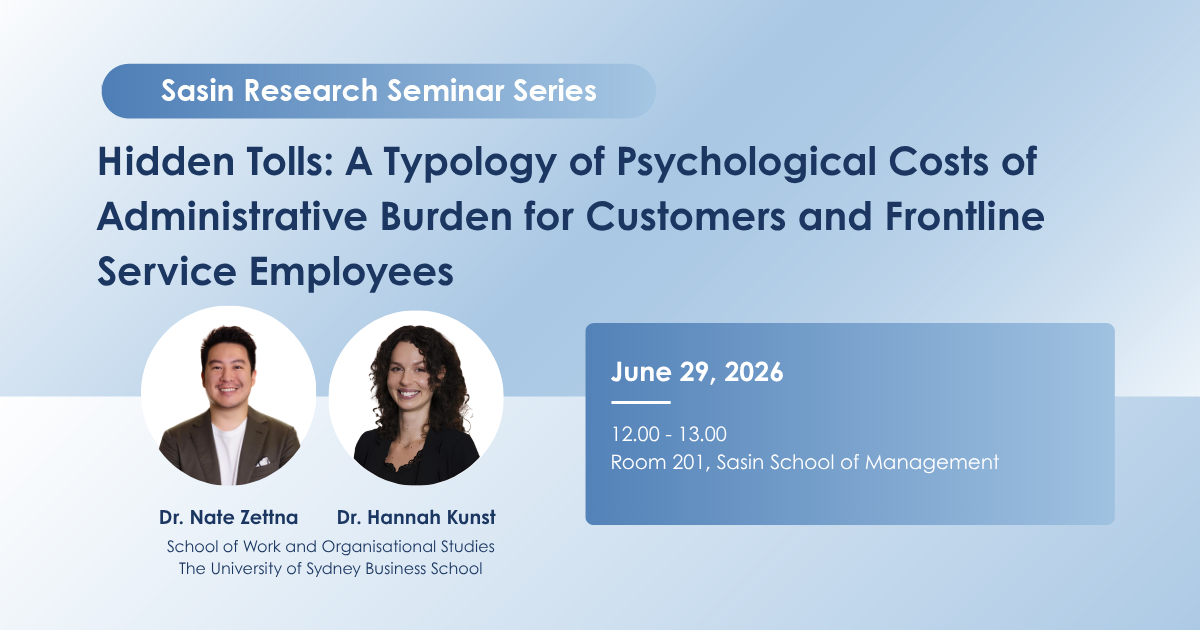
Hidden Tolls: A Typology of Psychological Costs of Administrative Burden for Customers and Frontline Service Employees
By: Dr. Hannah Kunst and Dr. Nate Zettna Lecturer in Leadership within the School of Work and Organisational Studies at the University of Sydney Business School. Date: Monday, June 29, 2026 Time: 12.00-13.00 Venue: Room 201 at Sasin School of Management or online via Zoom Register here to reserve your seat Abstract: This paper aims to disentangle the types of psychological costs – such as stigma, stress, and loss of autonomy – experienced by customers and frontline service employees when engaging with government and public services. We conducted a systematic review of 139 studies examining psychological costs experienced by customers and frontline employees across a wide range of government and public services. Using open, axial, and selective coding, we identify three overarching clusters in which psychological costs are situated: self (e.g., identity, autonomy), service (e.g., immediate emotional responses, engagement and avoidance), and system (e.g., inequality, discrimination). Our findings reveal clear service sectoral patterns: autonomy- and identity-related costs are most prevalent in welfare and social assistance, while lasting emotional states such as burnout and vicarious trauma are strongest among frontline workers in healthcare and general services. Psychological costs disproportionately affect marginalised populations, reflecting structural inequities. Institutional drivers such as procedural rigidity, digitisation, inconsistent information, and limited organisational capacity shape the emergence of psychological costs, particularly in sensitive contexts such as immigration, homelessness, disability services, reproductive health, and child welfare, where burdens compound and intensify. The review identifies and discusses reciprocal spillover effects: frontline employee strain exacerbates customer burden, and customer distress increases emotional labour for employees, creating self–service–system feedback loops. We highlight substantial gaps in measurement, cross-sector comparisons, longitudinal research, and intervention research, and outline directions for advancing the theoretical and practical treatment of psychological costs. For more information please contact +66-2218-4000 ext. 84095 or [email protected].Share this article
You might be interested in...