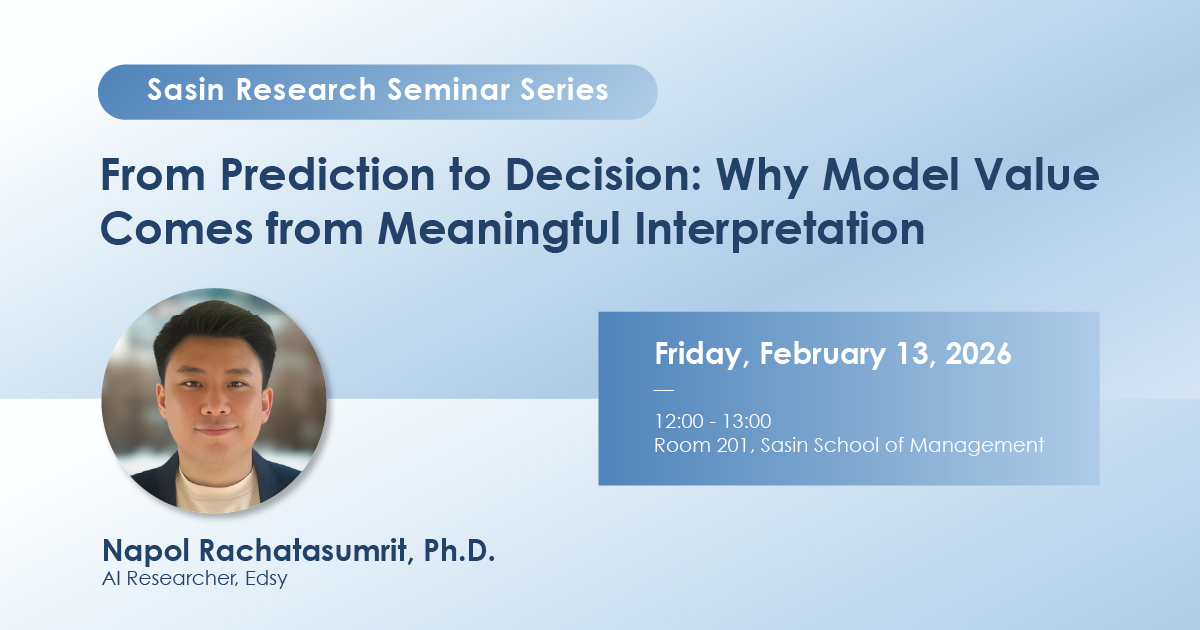
Sasin Research Seminar - Leader‑Expressed Humility: Development and Validation of Scales Based on a Comprehensive Conceptualization
03 December 2025

You are cordially invited to join Sasin Research Seminar.
Leader‑Expressed Humility: Development and Validation of Scales Based on a Comprehensive Conceptualization
By: Kraivin Chintakananda Assistant Professor of Management, University of Macau Date:Wednesday, December 3, 2025 Time: 12.00 – 13.00 Venue: Room 201 at Sasin School of Management or online via Zoom Register here to reserve your seat Abstract: This research examines how humble leadership is expressed behaviorally and expands current understanding beyond the traditional conceptualization of leader-expressed humility. Drawing on a nine-dimension conceptual framework grounded in prior inductive research and informed by philosophical and ethically oriented traditions, the study introduces two validated tools: the 27-item leader-expressed humility (LEH) scale and the concise 9-item Brief LEH scale. These measures capture the following behaviors of humble leaders: (1) having an accurate view of self, (2) recognizing follower strengths and achievements, (3) modeling teachability and being correctable, (4) leading by example, (5) showing modesty, (6) working together for the collective good, (7) empathy and approachability, (8) showing mutual respect and fairness, and (9) mentoring and coaching. Across studies conducted in Singapore and the United States, the findings demonstrate that leader-expressed humility predicts important outcomes such as leader performance, trust, and liking, above and beyond leader integrity and established leader humility scales. Regarding managerial implications, this research offers a diagnostic and developmental resource for cultivating humility in leaders. The LEH and Brief LEH scales enable organizations to identify specific strengths and gaps across the nine dimensions of humble behavior and to design targeted training and coaching interventions. By focusing on areas such as mentoring, fairness, or empathy, organizations can more effectively develop leaders who foster ethical conduct, psychological safety, and high-trust relationships, ultimately contributing to stronger workplaces aligned with organizational values. Building on this work, Kraivin is investigating how humble leader behaviors reduce the tendency for employees to dehumanize senior leaders. This project explores how actions such as showing empathy and acknowledging one’s limitations help humanize those in high-power roles, ultimately fostering healthier leader–follower relationships. In another work, he is investigating how targeted developmental interventions can strengthen specific humility dimensions and how these improvements influence leadership effectiveness. For more information please contact +66-2218-4000 ext. 84095 or [email protected].Share this article