How Economics Shapes Strategic Decision-Making
18 November 2026
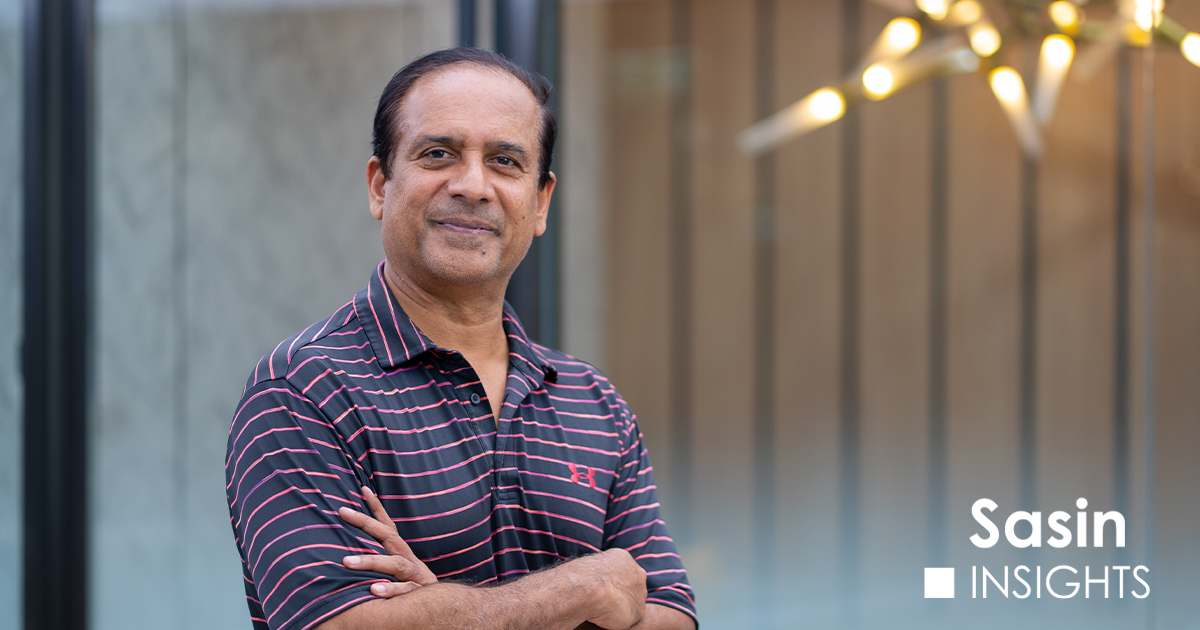
Ram Shivakumar is an Adjunct Professor of Economics & Strategy at the University of Chicago Booth School of Business. He joins Sasin this year as a Visiting Professor, where he teaches “Economics for Decision-Making” in the Sasin MBA program and “Strategic Economic Thinking” in the Executive MBA program. Both of Professor Ram’s courses at Sasin share a single aim: to help students make better decisions. Good decision-making, he argues, requires both thinking skills and action skills. In this interview, he shares the central ideas of his courses, the impact of AI on business and management, and his impressions of Sasin and its MBA students.
“Economics for Decision-Making” lays the economic foundations of how markets work. Students learn to understand the forces that drive consumer demand, determine a company’s cost structure, shape a company’s pricing, and how they influence the behavior of other players in the market. The goal is not so much to turn students into economists as it is to give them the tools to anticipate how markets will evolve.
“Strategic Economic Thinking” applies economic reasoning to business strategy. The course is built around a fundamental question: how do companies create value, and how do they capture it? By discussing cases on real companies facing a variety of serious challenges, students come to appreciate the importance of the strategy as well as the person behind the strategy, the strategist.
Professor Ram opens the course with a framework for how business leaders should think and act. The aim is to develop students’ mindset and skills along three dimensions: diagnosis, transformation, and persuasion.
“Diagnosis is the process of deciphering a company’s challenges and opportunities,” he explains. “The astute strategist does not try to solve every problem or pursue every promising opportunity. Weighing risks against rewards, she chooses the opportunities most worth pursuing.”
“Even smart, accomplished leaders get diagnosis wrong. Mike Lazaridis, co-CEO of Research In Motion, the company behind the BlackBerry, underestimated the iPhone because Apple was an outsider to the phone business,” he adds.
Transformation is where the hard work of translating diagnosis into action happens. What actions? How? When? In what sequence, and at what scale?
“In class, we studied Japan Airlines (JAL), one of Japan’s most iconic companies. In 2010, JAL went bankrupt. It took an outsider, Kazuo Inamori, to push through the changes in costs, pensions, and culture that restored it to profitability. How he did it is a master class in transformation.”
And then there is persuasion. For any business initiative to become successful, many stakeholders, including consumers, employees, suppliers, investors, and business partners, must cooperate.
“Many leaders fail to persuade people because they assume that data and logic are enough,” he says. “Persuasion requires a compelling story, one that wins people’s hearts as well as minds.”
AI as a Management Challenge, Not Just a Technological Challenge
At Chicago Booth, Professor Ram leads an executive program called “The AI-Ready Leader.” “It is a management program, not a program on AI,” he says. “The central message is simple: AI strategy must serve business strategy, not the other way around.” Companies everywhere are investing heavily in AI and urging employees to use it more intensively. But most are not yet seeing a financial return on those investments. In Professor Ram’s view, the problem is usually not the AI itself. It is the organization. To explain why, he refers to a framework developed by the late Stanford economist, John Roberts, called PARC, which stands for People (the attitude and aptitude of the company’s employees), Architecture (the delegation of authority and responsibility within the company), Routines (the company’s processes and management systems), and Culture (the behaviors of employees that reflect their beliefs). “PARC is a framework for looking inside the company, what we call the organization,” he says. “AI moves fast. But organizations do not. AI can generate thousands of options in seconds, but the organization still has to act. This is the bottleneck.” He saw this pattern in the memos his Sasin students wrote about their companies’ PARC. Regardless of the industries and sectors the companies operated in, the challenges the students identified were rarely technical. They were always organizational. “AI can inform a decision,” he says, “But it does not own the consequences of the decision. The human does.” This raises a deeper risk, one explored in a recent book that Professor Ram recommends. In this book, The Collision: What AI Does to Us, MIT professor Eric So argues that users of AI fall into two groups: those who use AI to think better, and those who use it as a substitute for thinking. The second path is seductive because it makes us think that we are more productive. The cost is that it erodes our capacity to think for ourselves, a phenomenon that Wharton researchers Steven Shaw and Gideon Nave call cognitive surrender. “This is the danger for leaders,” Professor Ram says. “If we let AI do our thinking, we gradually lose the judgment that strategy depends on. The best leaders will use AI as a demanding thought partner, one that challenges their assumptions, not one that gives them all the answers.”On Being a Professor at Sasin
Professor Ram, who has taught at Chicago Booth for 25 years, describes Sasin as an excellent business school with a warm, welcoming atmosphere: “What struck me immediately is that a substantial number of Sasin’s MBA students own and run businesses, and many are second- or third-generation leaders of family businesses. This fact changes the quality of the classroom discussions. Strategy is not just an abstract discipline. Students are evaluating the feasibility and merit of each idea within the context of their companies.” He also values their candor. “Sasin students want ideas they can use, and they will tell you when a course isn’t delivering that. I have been changing my courses in real time because of their feedback,” he says. “Thai students are more reserved in open discussion than American students. But give them a question to work through in small groups, or ask them to write a memo on a business challenge, and one can see how thoughtful and honest they are,” he adds. Professor Ram encourages students from abroad to consider spending a term or two at Sasin. “Most people know Thailand as a great place for a holiday. Few realize what a good place it is to study, work, and build a business. Students who come here will learn a great deal inside the classroom and just as much outside it. Thais are professional, polite, and remarkably effective, and working with them is an education in itself.”Share this article


