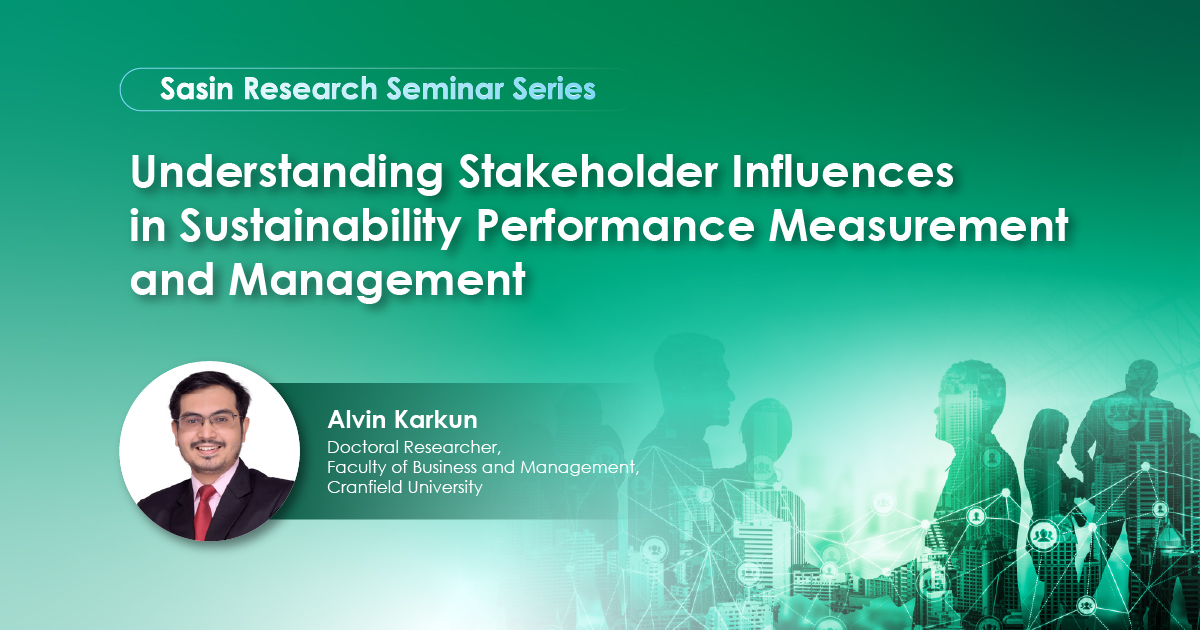
Understanding Stakeholder Influences in Sustainability Performance Measurement and Management
24 June 2026
Sustainability Performance Measurement and Management (SPMM) involves collecting, analyzing, and communicating information related to a firm’s sustainability performance to inform internal decision-making and disclosing relevant information to external business audiences.
Alvin Karkun, Doctoral Researcher at the Faculty of Business and Management, Cranfield University, gave insights into his research, “Understanding Stakeholder Influences in Sustainability Performance Measurement and Management,” based on a systematic literature review of 105 studies on the topic at the Sasin Research Seminar. The research synthesizes fragmented literature across multiple management sub-disciplines and identifies the types of influence different stakeholders impose on an organization’s SPMM, namely coercive, normative, mimetic, motivational, instrumental, and inhibiting. It also proposes an integrative framework that explains how these influences shape the design and implementation of SPMM systems by adopting a dual theoretical lens integrating neo-institutional theory and stakeholder theory.
Theoretical Foundations
Alvin defined two theories of how stakeholders influence SPMM and the types of stakeholder influence. The Neo-Institutional Theory holds that organizations tend to adopt similar rules, routines, structures, practices, and processes, achieving a state of isomorphism. The Stakeholder Theory states that the purpose of an organization goes beyond making profit for its shareholders, but also involves working in the best interest of its stakeholders who affect or are affected by the achievement of an organization’s objectives. These stakeholders can include employees, competitors, government and regulators, society, NGOs, and more.Types of Stakeholder Influence
Stakeholders can influence an organization’s SPMM broadly in two ways. On one hand, they can set expectations for organizations on how they can design and implement their SPMM systems, and on the other hand, they might directly influence the execution of SPMM system design and implementation. The influences setting expectations are coercive, normative, and mimetic influence, drawing on neo-institutional theory, while the influences affecting execution are motivational, instrumental, and inhibiting.Influences Setting Expectations
- Coercive Influence involves imposing mandates with legislative or regulatory requirements and policies emphasizing more transparency and mandatory environmental and social disclosures. They can enable firms to strategize for sustainability management and shape their sustainability accounting with suitable measurement criteria, frequency, and targets. This can be done through mandatory certifications, rigorous audits, and participation in benchmarking projects for improving organizational sustainability performance. For example, governments require companies to be transparent through mandatory disclosure. This can come from large customers who prefer working with compliant organizations, regulators who can file legal proceedings, and stakeholders such as media and NGOs who can expose negative practices.
- Normative Influence is not mandatorily imposed on organizations, but failing to align SPMM with certain norms can limit business opportunities. A prime example is the sustainability standards developed by the International Organization for Standardization (ISO), which have become an industry norm. Thus, this influence operates through advocating norms and guidelines set by stakeholders like standardization organizations or NGOs/NPOs, or by stakeholders like customers who may tend to seek legitimacy of organizations in their efforts to manage sustainability performance.
- Mimetic Influence reflects how organizations follow stakeholders like competitors, setting targets based on industry benchmarks and best practices. Firms face pressure to benchmark their performance and set stronger targets, while some third-party organizations estimate the overall sustainability contribution required across an industry, resulting in similar goals. Firms may also follow other highly rated firms in their industry to formulate sustainability strategies. It can allow them to understand what indicators and targets are suitable within their industry.
Influences Affecting Execution
- Motivational Influence involves building a sustainability culture within an organization so stakeholders can develop a shared understanding. This includes setting vision and commitment by stakeholders like the leadership and managers. Leaders (especially the chief sustainability performance managers), mid-level managers, and internal sustainability committees can foster a common knowledge of sustainability and its performance evaluation by promoting reporting and embedding materiality assessments within their firms. By promoting this in every department/BUs, they can make employees more sustainability-conscious. Commitment of employees to learn and share can also motivate organizations as a whole to execute SPMM. Furthermore, stakeholders can provide support as well, which can motivate firms to execute SPMM. For example, leaders can allocate budget and multi-disciplinary teams, governments offer incentives or financial aid to organizations that advance sustainability management programs, or local communities can also undertake voluntary environmental monitoring that can help firms shape their SPMM better.
- Instrumental Influence is where most of the practical work gets done. Stakeholders like analysts, consultants, or auditors play a key role by bringing their expert knowledge and judgment, providing information, and assuring quality through data validation and report review. This includes developing metrics, setting targets, conducting materiality assessments, and collecting context-specific and measurement-specific data from markets, suppliers, legislation, customers, and stakeholder councils.
Inhibiting Influence
However, not all influences may drive SPMM. Stakeholder influence can also hinder effective SPMM. For example, governments may not prioritize sustainability, leading to weak enforcement and deregulated practices that result in low reporting rates or limited focus on global sustainability agendas like the UN SDGs. Lack of political support, incentives, and the risk of corruption can further hinder organizational efforts. Society’s low perception of the importance of SPMM can also result in a lack of commitment from organizational leaders. Standards by standardization organizations are mostly designed for large businesses and may not adequately support SMEs. Additionally, organizations may fail to acquire the necessary capabilities or resources from stakeholders, face limited access to data, or encounter resistance from certain internal stakeholders towards changes related to sustainability — particularly among management accountants who may view sustainability accounting as time-consuming and resource-intensive. CEOs may also disregard boards’ advisory roles, restricting investment in SDG-based initiatives and their inclusion in reporting. Overall, the research provides necessary guidance to managers on what stakeholders expect of firms regarding sustainability management and how to design and implement their SPMM systems. Furthermore, it shows managers how stakeholders themselves can contribute to the execution of SPMM in firms through their skills, knowledge, or commitment. However, in some cases, managers may also need to navigate the negative influence of stakeholders, which can be a direct barrier to the execution of SPMM in their organizations. Even though some stakeholders may not support the sustainability agenda, the benefits of measuring and managing sustainability performance effectively could be immense— whether in enhancing the firm’s reputation, securing investments, or reducing costs. Hence, managers must strive to persuade and engage both internal and external stakeholders in SPMM, considering their holistic viewpoints, interests, and the value they can add to the process.Share this article
You might be interested in...