2025 Sustainability in Finance and Capital Market Development: ESG, Climate Change, and AI Conference
25 November 2025

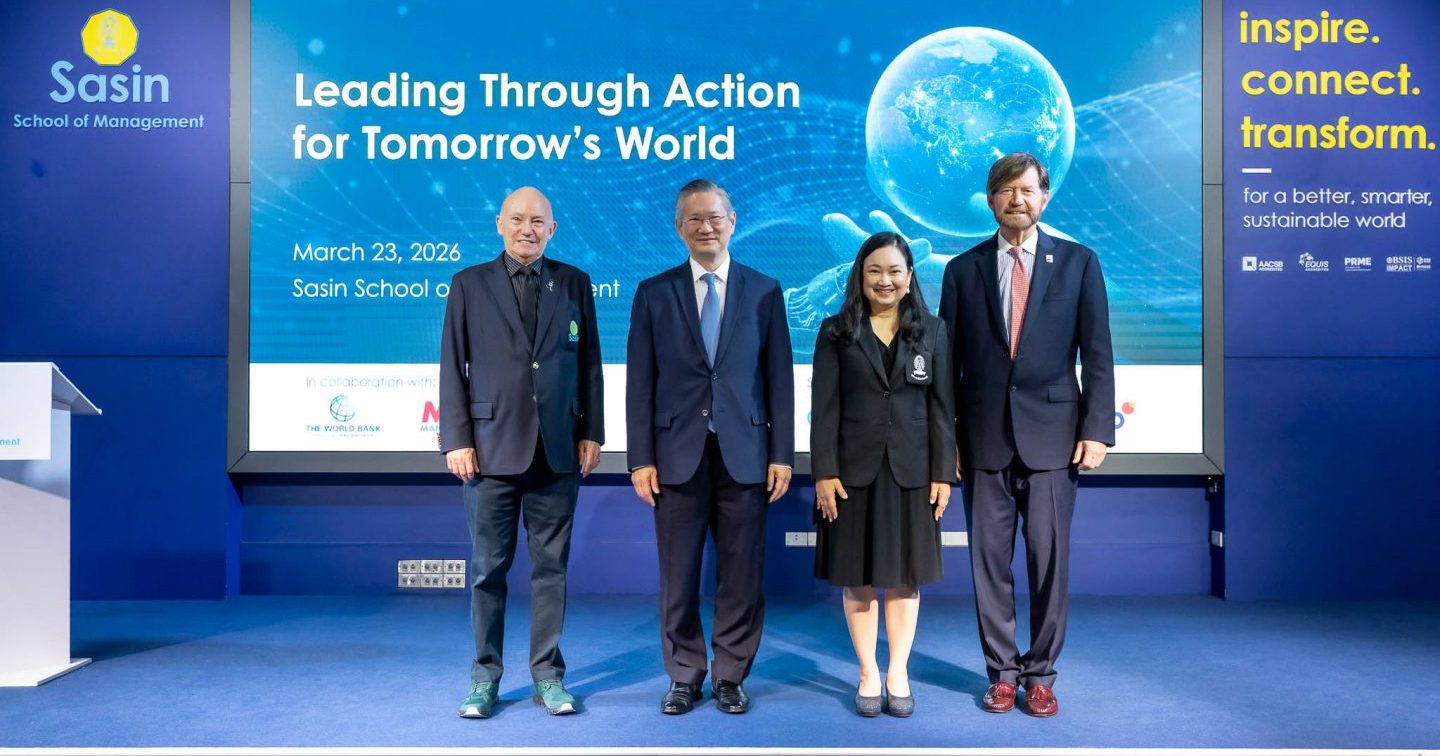
Sasin and the National Research Council of Thailand co-hosted the “2025 Sustainability in Finance and Capital Market Development: ESG, Climate Change, and AI Conference” on November 5, bringing together academics, industry leaders, and policymakers to explore how ESG, climate change, and AI are reshaping the financial sector.
Associate Professor Kriengkrai Boonlert-U-Thai, Vice President of Chulalongkorn University, emphasized the importance of collaboration in advancing research and innovation. He noted that the way we build a better future together has changed, with collaboration among universities, businesses, and policymakers being key to driving real progress. This approach represents a true form of collaboration in action.
Dibyendu Bose, Sasin’s Deputy Director of Strategy, Innovation & Impact, noted that the intersection of ESG, climate change, and AI is central to shaping tomorrow’s landscape. He welcomed the participation of international partners, including educational institutions from Australia, emphasizing the value of global collaboration.
The keynote address was delivered by Professor Banita Bissoondoyal-Bheenick, Director of Research Services and Programs at RMIT University. She shared insights on her collaborative research, “Sustainable Banking: Unleashing the Potential of ESG Media Reputation for Stable Financial Systems.”
“The world’s 60 largest global banks had extended 3.8 trillion dollars in loans to the fossil fuel industry, contravening their own stated policies and commitments,” said Professor Banita, emphasizing the growing gap between policy and practice in global finance.
The research found that a strong ESG media reputation can significantly enhance bank stability by attracting more stable customers, improving loan quality, and strengthening stakeholder trust. Conversely, a damaged ESG reputation exposes banks to financial, regulatory, and reputational risks. She concluded that banks must improve ESG transparency, investors should pay close attention to media coverage of ESG for their respective banks, and regulators should require banks to disclose ESG performance and climate impacts.
Associate Professor Kanis Saengchote from the Department of Banking and Finance at Chulalongkorn Business School, Member of the Payment Systems Committee at the Bank of Thailand, and an Advisor to the Stock Exchange of Thailand shared his insights on the “Tax Incentives and the Cost of Sustainable Debt: Evidence from Thailand’s ESG Fund Policy.” He presented findings on Thailand’s ESG Fund scheme, launched in December 2023, which offers tax incentives to investors. While Thailand’s ESG fund market grew to 30 billion baht by the end of 2024, his analysis suggests that most ESG fund investments flow into government bonds rather than corporate issuances. Although corporate ESG bond issuance has increased, he noted that the scheme appears to help government issuers more than corporates.
Dr. Nophea Sasaki, Sasin’s Professor of ESG and Sustainability, outlined how AI can strengthen ESG reporting and carbon accounting. With data gaps common even among large firms, AI can fill data gaps, validate compliance with regulatory requirements, and support complex tasks such as emissions baseline calculations and environmental monitoring.
The panel discussion on “ESG, Climate Change and AI” brought together Dr. Non Arkaraprasertkul, Senior Expert in Smart City Promotion at the Digital Economy Promotion Agency and Smart City Office (DEPA); Dr. Warodom Khamphanchai, CEO at AltoTech Global; Dr. Papon Yongpisanpop, Senior Training Advisor Manager at Alibaba Cloud International; and Sasin’s Professor Nophea Sasaki. They discussed smart cities, cloud infrastructure, and incentive-driven adoption. Speakers emphasized that AI can transform energy efficiency, reduce carbon footprints, and support more transparent ESG practices across industries.
The conference concluded with a reminder from Professor Sirimon Treepongkaruna, Sasin’s Head of Sustainability in the Financial & Capital Market Development Research Unit and Emeritus Professor at The University of Western Australia Business School, that while innovation and sustainability are vital in shaping our future, they must be guided by the right purpose and grounded in ethical balance.


Share this article