SME How to Scale Expo 2025
30 December 2025

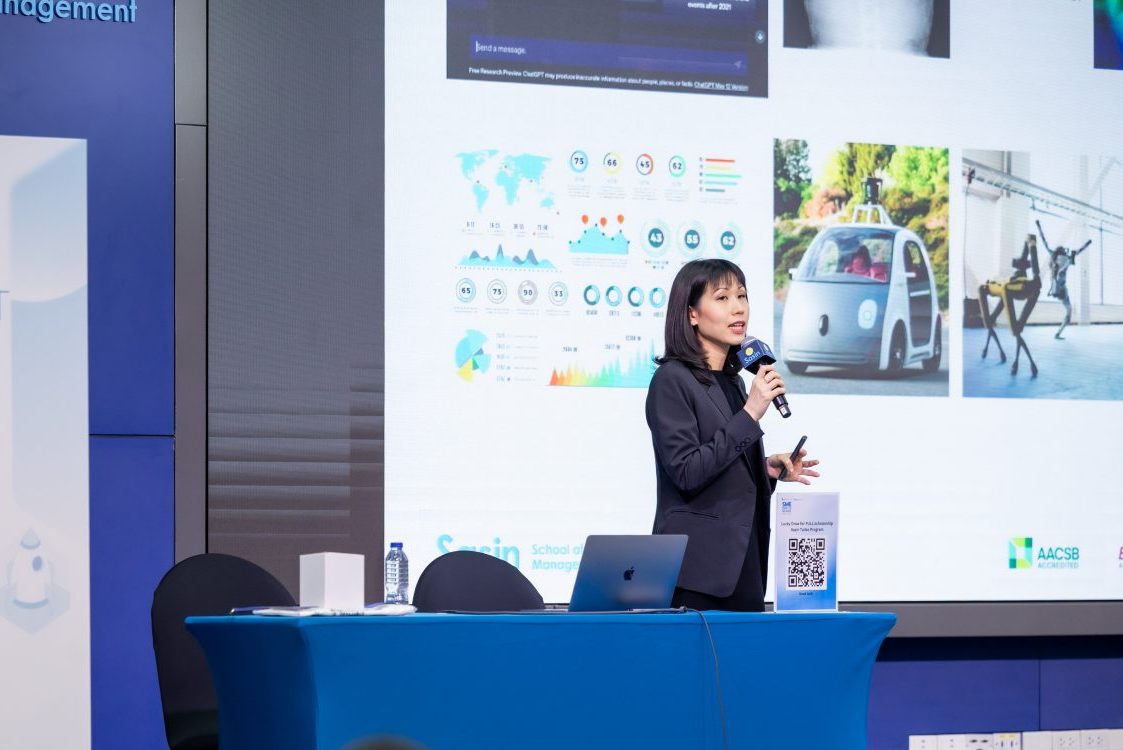
Sasin and FlowAccount co-hosted “SME How to Scale Expo 2025,” a two-day event designed to help SME founders and leaders accelerate growth with practical, MBA-style learning. Sasin’s Faculty members, Dr. Pinnaree Tea-Makorn, AI Strategist, and Associate Professor Piyachart Phiromswad, Deputy Director of Learning Solutions, spoke on the sessions “Scale Smarter and Faster with AI” and “Regional Readiness.”
Here are three insights from Dr. Pinnaree’s session on “Scale Smarter and Faster with AI”:
- Shift from Non-Agentic (Zero-shot) to Agentic AI Workflows: Non-agentic AI requires breaking complex tasks into smaller steps or prompts to get better results. Since it doesn’t make decisions on its own, it needs to follow a sequence of instructions. On the other hand, agentic AI can autonomously manage multiple processes, like content creation or call center operations, by acting as a central “brain” that coordinates different AI tools to achieve specific goals.
- Unsupervised Learning Uncovers Hidden Patterns. Unsupervised learning helps AI find natural groupings in data without predefined labels. For example, clustering potato chip sales data reveals price-based buying patterns, while it can also identify objects like cats in unlabeled YouTube videos. This technique allows AI to discover insights and relationships within data, driving smarter decisions.
- Large Language Models (LLMs) require four communication principles: Priming (providing context), Prompting (clear instructions), Polishing (refining outputs), and Probing (deeper analysis).
- Start with a Brainstorming Framework:
- Think about how to apply AI to make work more efficient for your organization. The focus should be on optimizing specific tasks rather than automating entire jobs, such as improving call center routing or enhancing radiologists’ diagnostic capabilities.
- Consider how AI can enhance efficiency and address key business challenges in your organization by asking questions such as, “What are the main drivers of business value?” and “What are the pain points in your business?”
- Execute Pilot Projects to Gain Momentum:
- Undertake practical AI projects to gain experience and understand the process of building an AI project, which helps to formulate a sound strategy.
- Build an In-House AI Team:
- Establish an AI specialty team within the business unit.
- The AI function can be positioned under the Chief Technology Officer (CTO), Chief Information Officer (CIO), Chief Data Officer (CDO), etc.
- Provide Broad AI Training:
- Ensure employees across the organization have a basic understanding of AI and its applications.
- Develop an AI Strategy:
- Leverage AI to create an advantage specific to your industry sector.
- Design a strategy aligned with the “Virtuous Cycle of AI”: Companies should develop AI strategies aligned with their industry’s “Virtuous Cycle of AI” and establish robust data strategies to create sustainable competitive advantages.
- Consider creating a data strategy that includes strategic data acquisition and a unified data warehouse to create network effects and platform advantages.
- Develop Internal and External Communications:
- Focus on investor relations, government relations, customer/user education, talent recruitment, and internal communications to ensure a cohesive approach to AI integration.
- Products currently popular will become obsolete—SMEs must avoid solving the wrong problems. If you’re investing in a product or idea, by the time you launch it, it could become obsolete. The trend is moving towards products, services, and experiences that are customized on demand (based on the concept called “proximity” by Robert Wolcott, Adjunct Professor of Executive Education, Kellogg School of Management). SMEs need to constantly question whether they’re addressing problems that will still matter in the future.
- Focus on regional expertise. Success requires regional-specific knowledge, regional-specific data, and regional-specific connections (less focus on global or local). Instead of prioritizing global or local approaches, emphasize understanding the unique dynamics and needs of a particular region to drive growth and relevance.
- People will pay for quality products that make a big impact. Consumers will invest more in quality products and enterprises that come at a premium price due to their long-term impact. For example, international schools may cost millions, but parents believe it will make an impact on their children’s future, so they are able to invest in it. The key is demonstrating transformative value, not just functionality.



Share this article