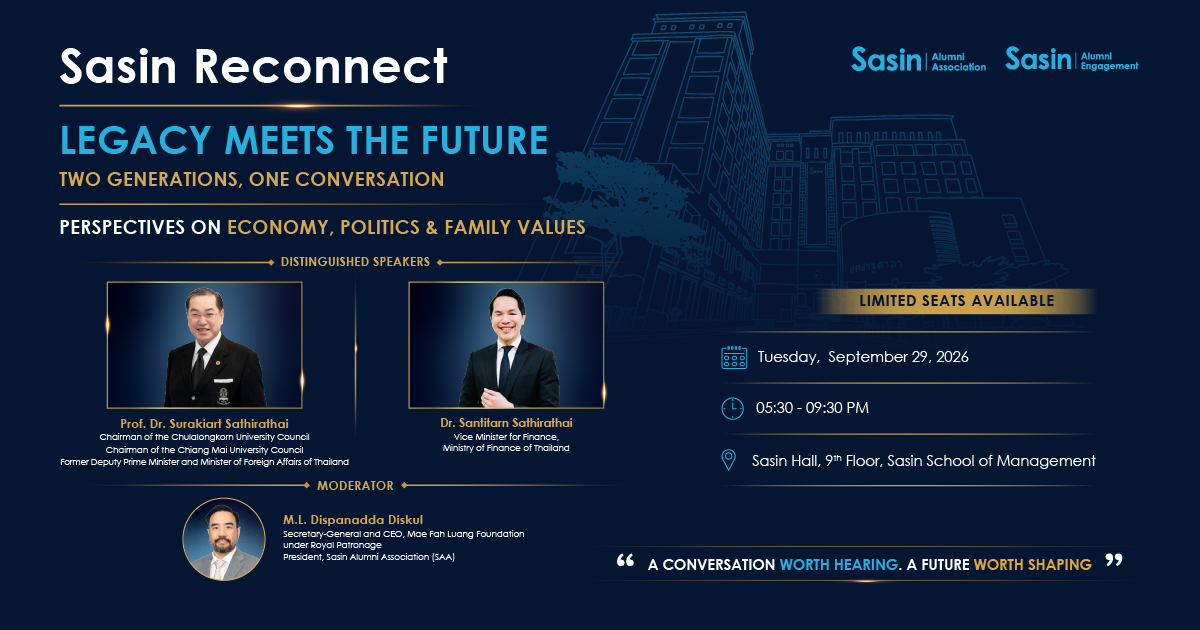
Sasin Research Seminar - When AI Reads the 10-Ks: The Effects of ChatGPT on Trading and Price Dynamics
18 May 2026
You are cordially invited to join Sasin Research Seminar.
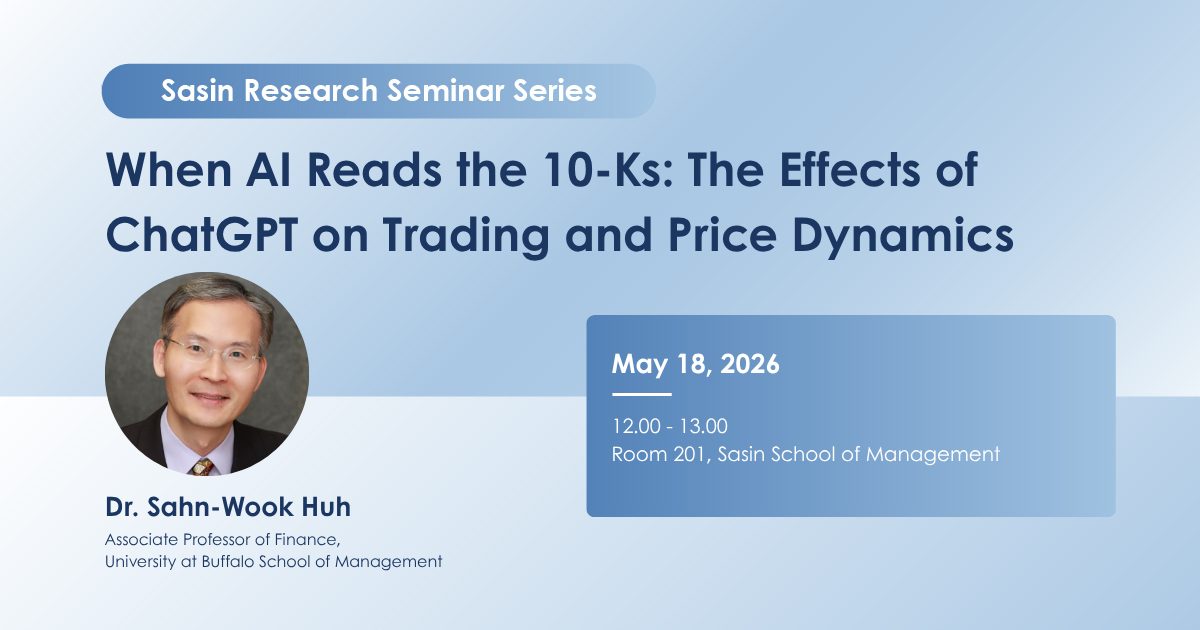
When AI Reads the 10-Ks: The Effects of ChatGPT on Trading and Price Dynamics
By: Dr. Sahn-Wook Huh, Associate Professor of Finance, University at Buffalo School of Management Date: Monday, May 18, 2026 Time: 12.00-13.00 Venue: Room 201 at Sasin School of Management or online via Zoom Register here to reserve your seat Abstract: We examine how the release of ChatGPT has reshaped the informational structure of the U.S. equity market. By introducing CSA, a new metric that can measure ChatGPT’s ability to interpret firm disclosures, we show that generative AI reduces information asymmetry and changes trading dynamics. Using a DiD approach, we find that companies with high CSA observe significant decreases in informed trading and adverse selection costs, along with lower return volatility. These findings suggest that ChatGPT helps to make complex disclosures more understandable, narrowing the gap between retail and institutional investors. The analyses show that the impact is asymmetric: AI tools have a stronger influence on informed buying than on informed selling, reflecting behavioral selectivity. Additionally, while informed trading decreases, overall order imbalances increase, especially among retail investors, indicating a greater consensus when interpreting public information. These patterns highlight that AI tools enhance market quality not by providing private signals but by enabling better processing of public data. That is, AI-assisted interpretation can significantly improve retail investors’ decision-making without access to private information. The findings have significant implications for regulation and policy. Traditional efforts like Reg FD and EDGAR focused on access; However, generative AI expands this scope by improving interpretability. Regulators may need to develop disclosure standards that are more detailed and machine-readable to fully utilize AI’s benefits. Simultaneously, our evidence shows variation across industries: democratization effects are stronger in disclosure-rich, stable industries, while narrative-driven sectors tend to be more affected by information asymmetry. Therefore, AI both equalizes and creates disparities in informational advantages, shaping a market where fundamentals and narratives coexist. These results leave an open question about its long-term balance and interaction with other technological and behavioral factors, as both institutional and retail traders adapt to AI-driven financial markets and economies. Addressing these issues warrants further research. For more information please contact +66-2218-4000 ext. 84095 or [email protected].Share this article