Family Control and Ownership, Corporate Culture, and ESG Performance in Thailand
14 July 2026
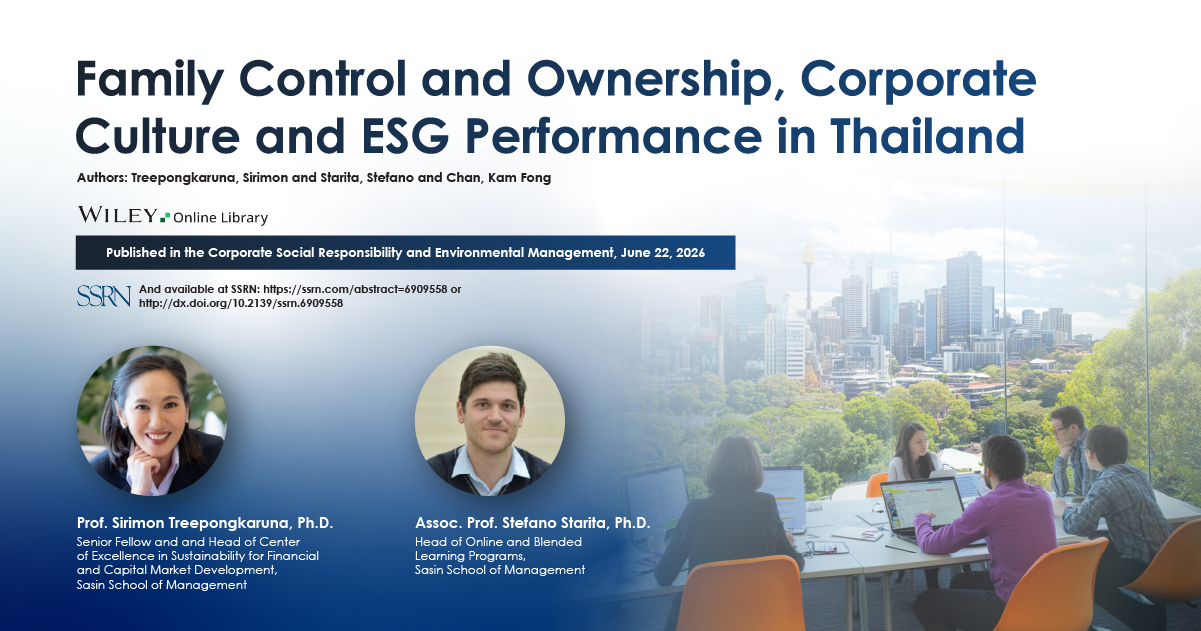
A publication by Professor Sirimon Treepongkaruna, Ph.D., Senior Fellow and Head of the Center of Excellence in Sustainability for Financial and Capital Market Development and Associate Professor Stefano Starita, Ph.D., Head of Online and Blended Learning Programs at Sasin School of Management, examines how family control, ownership, and corporate culture influence the environmental, social, and governance (ESG) performance of publicly listed firms in Thailand.
Motivated by the growing importance of ESG performance in emerging markets, the study finds that family control and corporate culture have positive impacts on ESG performance, while pure family ownership has a more limited effect. A one-standard-deviation increase in corporate culture is associated with a 46% increase in ESG performance, while family control with at least 20% ownership stakes is associated with a 14% increase.
The findings suggest that corporate culture can strengthen the ESG benefits of family control, supporting the stewardship perspective. At the same time, the muted effect of pure family ownership reflects concerns related to the expropriation perspective. As ESG performance becomes increasingly linked to firm competitiveness, the study highlights family control with ownership stakes and corporate culture as important determinants of corporate sustainability, with implications for governance design and responsible investment.
Read the article on Wiley Online Library
Share this article
You might be interested in...