Eain Dray Aung: Women of the Future 50 Rising Stars in ESG
12 October 2026
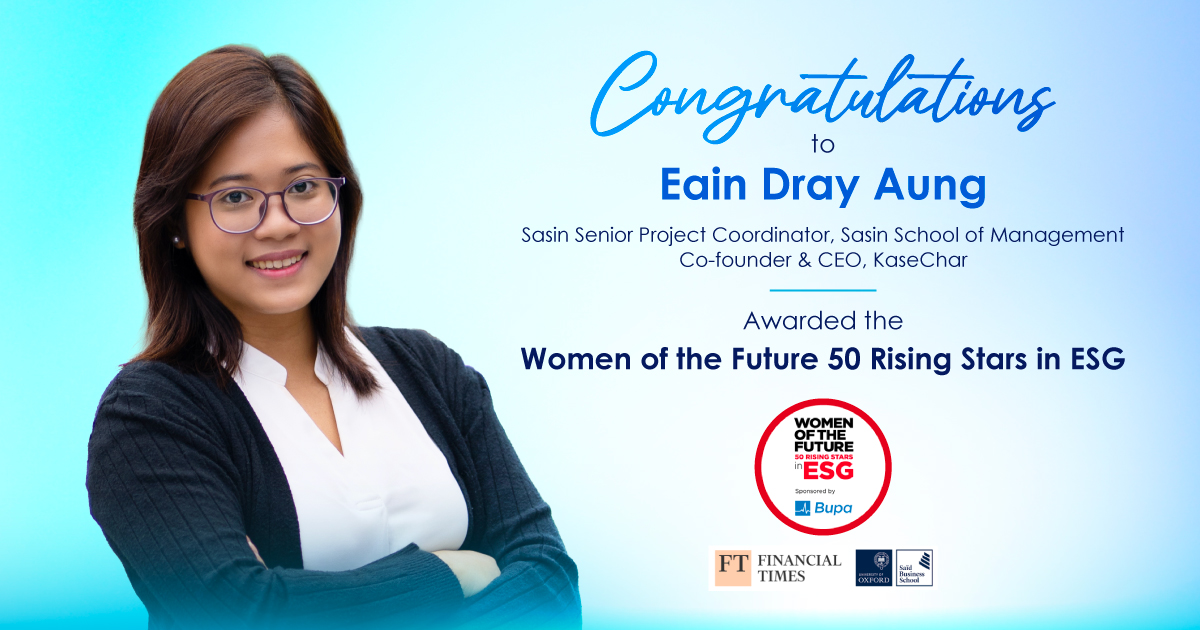
Eain Dray Aung, Sasin Senior Project Coordinator, was recently awarded with the Women of the Future 50 Rising Stars in ESG. The annual award celebrates talented female trailblazers and role models aged 35 and under from all over the world who are at the forefront of ESG, showcasing 50 rising stars across different aspects of ESG who have made a lasting and positive impact on their organisations, environment and wider society.
“An interest in sustainability and business led me to work more closely with farmers, and then into research and climate technology. So, being selected for this award is meaningful to me because it recognizes my journey in the ESG field, which is still growing,” said Eain Dray. “I also hope it encourages other young women in Southeast Asia to explore this field.”
Eain Dray is the co-founder and developer of KaseChar, a mobile application she prototyped as part of her master’s thesis at the Asian Institute of Technology (AIT). The app is designed to improve local livelihood and reduce open-field burning by promoting agricultural waste management and marketplace in Chachoengsao Province, eastern Thailand.
KaseChar gained international recognition when Eain Dray Aung received the Young Southeast Asian Leaders Initiative (YSEALI) Professional Fellows Program Finalist Award 2025 in the Sustainability & Environment category from the U.S. Department of State. This year, KaseChar also won First Prize in the Southeast Asian Division of the ISETS-ESCAP Youth Voice Competition 2026 and was named one of the Global Top 9 finalists advancing to the Global Final in China.
“I had the chance to talk with farmers about the problems they face, especially crop burning. That conversation led us to ask how we could use AI-powered technology to solve these problems, and the result was KaseChar,” said Eain Dray. The name combines “Kase,” which means “farmer,” and “Char,” short for biochar, a material that enriches the soil with nutrients while storing carbon in the soil. KaseChar turns agricultural waste into biochar, which can then go back into the soil as an organic fertilizer and carbon capture. The goal is to encourage farmers to manage their crop wastes for multiple ecosystems, benefitting from extra income from improved crop productivity and carbon credits. KaseChar is now in its second phase, and Eain Dray hopes to scale up so that more farmers can benefit from turning their crop waste and sustainable farming into something valuable.
Her work on KaseChar is also backed by peer-reviewed articles and academic recognition. Eain Dray won First Place in the Infrastructure and Digital Transformation Cluster of the ADB-Japan Scholarship Program (ADB-JSP) Thesis of the Year Award 2026. Her award-winning research examined how digital innovation can support sustainable agricultural waste management in Thailand.
In the Bangkok Business Challenge 2024 and 2025, hosted by Sasin and powered by SCGC, KaseChar and Krufarm, another climate-tech startup Eain Dray was part of, were selected as semi-finalist teams representing Thailand in the global student startup competition.
After joining Sasin in 2025 as a Sustainability Creator of the Sasin ESG Unit, Eain Dray further developed sustainability technologies to assess sustainability performance and green urban management. She co-founded RabbitESG and TreeTaishi and supported the development of Krumap. All these three technologies received Gold, Bronze, and Silver Medals, respectively at the Bangkok Intellectual Property Invention Innovation and Technology Exposition (IPITEx 2026) on “Thailand Inventors’ Day,” hosted by the National Research Council of Thailand (NRCT). These technologies are also co-founded by Professor Nophea Sasaki, Sasin Core Faculty in ESG and Sustainability.
In addition to research and development, Eain Dray also supports Sasin’s Sustainability Action Learning Lab, where she assists students in framing their sustainability reports and presenting to clients. She has also established connections with like-minded people from diverse backgrounds in sustainability and business. “Sasin is a great environment to learn and where I can turn my research into practical solutions that can become a sustainable business that I can keep working on,” she said.
When asked about the advice she would give to someone who wants to create a sustainability startup, she has this to say: “Start with a real problem to understand the solutions of market pain points and spend time for the development of those solutions. Take small steps, test your idea, and measure what actually changes. Think about whether people can solve their daily problems and use it in their everyday lives. You don’t need every answer at the beginning. Be willing to listen, learn, and adjust.”
Share this article