Sasin Research Seminar - Understanding Stakeholder Influences in Sustainability Performance Measurement and Management
16 January 2026

You are cordially invited to join Sasin Research Seminar.
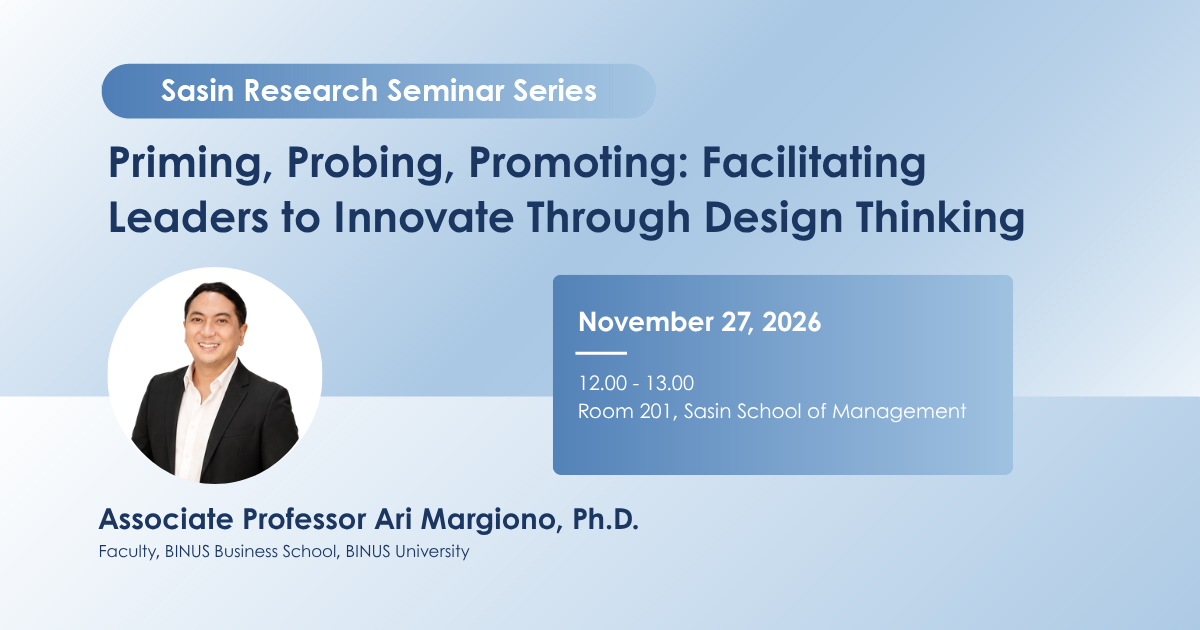
Understanding Stakeholder Influences in Sustainability Performance Measurement and Management
By: Alvin Karkun Doctoral Researcher, Faculty of Business and Management, Cranfield University Date: Friday, January 16, 2026 Time: 12.00 – 13.00 Venue: Room 206 at Sasin School of Management or online via Zoom Register here to reserve your seat Abstract: Sustainability Performance Measurement and Management (SPMM) is crucial for businesses to maintain long-term growth and implement strategies to create not only economic, but also social and environmental value. It is increasingly recognised that organisations need to address their stakeholders’ demands or interests and acknowledge them as an integral part of measuring and managing corporate sustainability performance. Despite this increasing awareness, the stakeholder perspective in the SPMM literature is fragmented across different management sub-disciplines and lacks a comprehensive understanding of how stakeholders influence an organisation’s SPMM system. Through a systematic literature review of 105 studies, this research synthesises the fragmented literature across multiple management sub-disciplines and identifies the types of influence different stakeholders impose on an organisation’s SPMM, namely coercive, normative, mimetic, motivational, instrumental, and inhibiting. It also proposes an integrative framework that explains how these influences shape the design and implementation of SPMM systems in organisations by adopting a dual theoretical lens that integrates neo-institutional theory and stakeholder theory. This research work has potential business implications. First, it shows how the influences of a network of both internal and external stakeholders can shape an organisation’s SPMM system, conveying to managers the necessity of adopting a unified stakeholder perspective instead of a siloed approach to sustainability management, by working together with stakeholders across various business functions within their firms, as well as outside. By doing so, they can fulfil diverse stakeholder interests and gain stakeholder trust while making meaningful sustainability disclosures. Furthermore, the proposed framework can act as a diagnostic instrument, helping managers understand the expectations that different stakeholders have of organisations regarding SPMM. Additionally, it explains how stakeholder influences can not only create such expectations, but also affect the execution of SPMM activities, thereby translating those expectations into organisational actions for measuring and managing sustainability performance. As an extension of this work, a future empirical research project is currently being pursued to explore how firms engage with their stakeholders for SPMM. Through a multiple case study in Europe, the research delves into various stakeholder engagement practices that firms adopt to involve stakeholders in measuring and managing their sustainability performance. The project is part of a fully funded Doctoral Studentship at Cranfield University, UK. For more information please contact +66-2218-4000 ext. 84095 or [email protected].Share this article